
The Bioinformatics and Computational Biology Laboratory provides computational resources for performing laboratory practicals
which constitute part of requirements for obtaining required academic credits in various degree programs offered by the University. The laboratory infrastructure is particularly important for completing by students the Minor and / or Major Research Projects aimed at obtaining aforementioned academic credits.
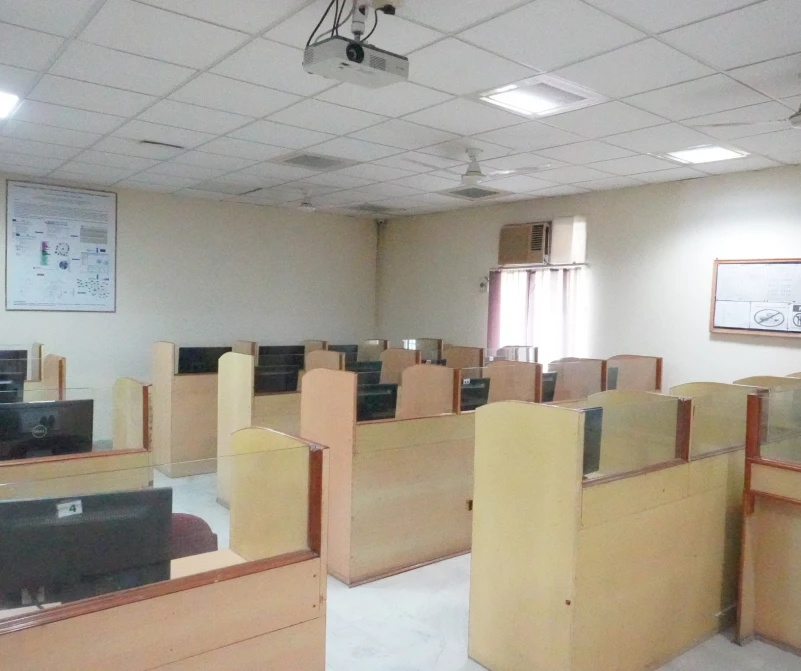
The laboratory is primarily used by all students of academic degree programs namely, B.Sc in Biotechnology, M.Sc in Biotechnology and Microbiology and Immunology, B.Tech in Biotechnology, and Ph.D in Biotechnology for conducting the regular practical sessions, project development and periodical teaching-learning activities.
The laboratory is well-equipped with high-end computer systems with relevant softwares for designing, developing, testing, and implementing various computational algorithms and software application solutions. Students engage in this laboratory on periodical practical laboratory sessions under the supervision of appointed teaching faculty. The teaching faculty engages students in solving real-world problems, prepare project reports, prepare documentation, prepare presentations, and present final project presentations.
Additionally, the computer systems in the laboratory are well-equipped with essential softwares for machine learning, data analysis, computational experimentation, particularly useful for developing academic projects. This laboratory infrastructure is expected to develop students’ analytical ability, problem-solving skills, and innovation skills through engagement in solving real-world problems, developing computational solutions to the problems and in-turn developing software applications to the problems. This is further expected to enhance the prospects of students of the Department of Biotechnology seeking successful placements in industries that are driven by value-added growth in the field of information sciences.
MAJOR AREAS:
The laboratory supports practical work in machine learning, artificial intelligence, and data science particularly aimed at data pre-processing, data analysis, hypothesis testing and obtaining statistical conclusions. Additional computational areas include computer programming and software development, requirement analysis and system design, software architecture and design patterns, model development, training, testing and evaluation, application, development and implementation, and project documentation and presentation.
Equipment:
HP 280 G-9, 12th Generation-Intel ® Core TM i5-12400, 8 GB DDR-4 RAM, 512 GB SSD HDD, Keyboard and Mouse. Network Switch D-Link DES 1024 D (24 Port), ViewSonic Projector, UPS power supply.
Software:
The lab systems are equipped with the following updated software and tools: Windows 11 – 64-bit; Microsoft Office 2021; Mozilla Firefox; Google Chrome; Dev-C++; Visual Studio; C Compiler; JDK Java 1.8; and Python 3.14.
Lab Utiliazation:
The laboratory is particularly utilized for
- Regular Academic Practical Sessions
- Computer Programming Using Different Programming Languages
- Training Mathematical Models Using Machine-Learning Algorithms
- Training Students for Artificial Intelligence Algorithms
- Training Students for Performing Big Data Analysis
- Conducting Training Sessions for Completing Minor and Major Projects as a Part of Academic Requirements
- Mathematical Modeling of Molecular Processes
- Data Analysis Sessions for Ph.D. Scholars
 Virtual Tour
 B.Tech Programs
UG Programs
Lateral Entry
M.Tech Programs
PG Programs
Doctoral Programs
Diploma Programs
Admissions Helpline

-

-

-

-

17km Stone, NH-19, Mathura-Delhi Road, P.O.
Chaumuhan, Mathura-281 406, (U.P.) INDIA